In this guide
- Do You Need a Degree or License to Become a Dispatcher?
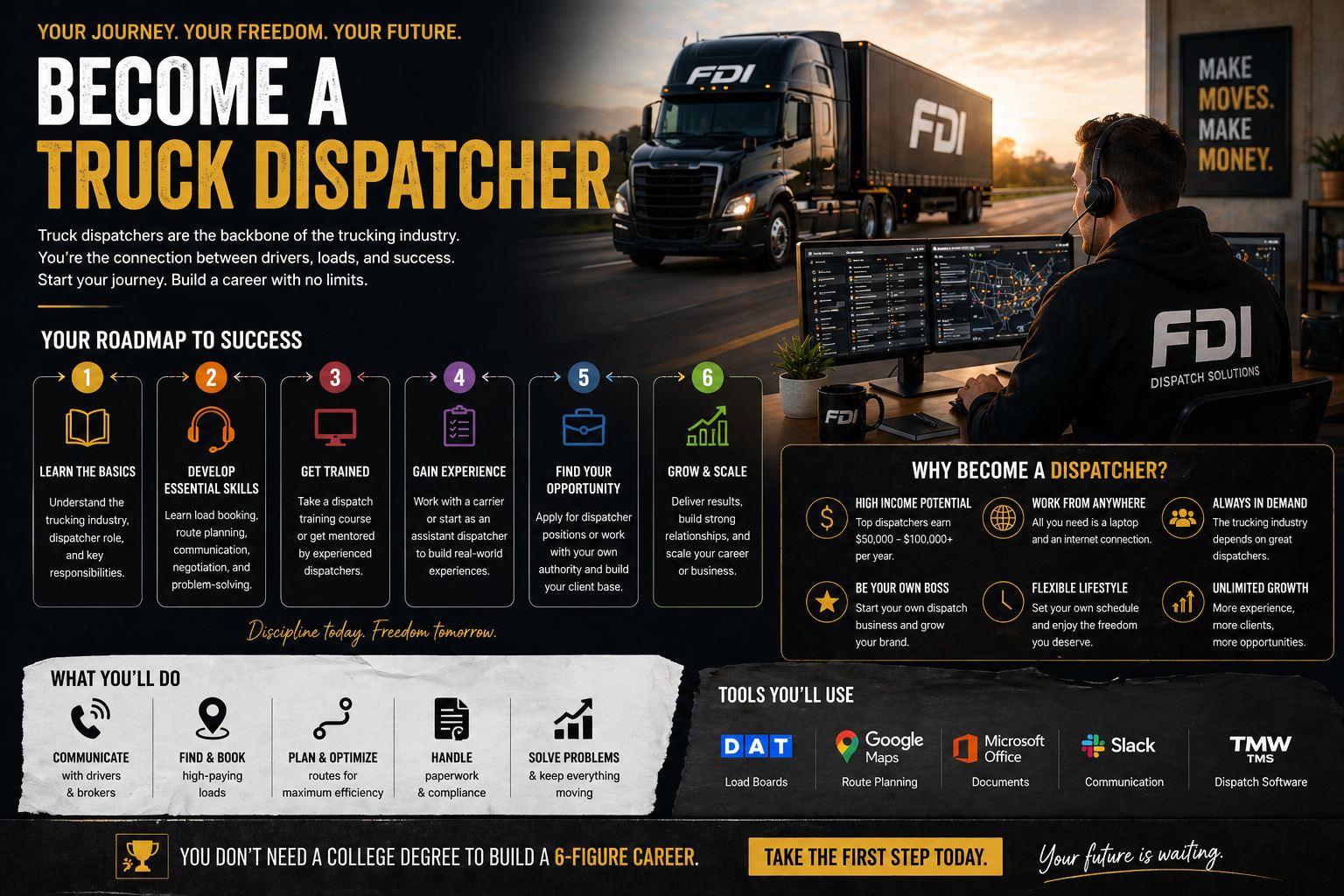
- Step 1: Learn How the US Trucking Industry Works
- Step 2: Build the Core Dispatcher Skills
- Step 3: Get Structured Dispatch Training
- Step 4: Learn the Dispatch Tools
- Step 5: Get Practical Experience
- Step 6: Choose Your Career Path
- Step 7: Set Up Your Dispatch Business (If Going Independent)
- Step 8: Find Your First Carrier and Dispatch Your First Load
- Common Mistakes New Dispatchers Make
- Frequently Asked Questions
You can become a truck dispatcher without a college degree or a government license. What you do need is a solid understanding of how US trucking works, practical skills in load booking and negotiation, familiarity with dispatch tools, and a plan for getting real experience. This step-by-step roadmap takes you from complete beginner to dispatching your first load.
Key takeaways
- No degree or dispatcher license is required, but dispatchers must stay within US broker rules.
- Learn the industry first: carriers, brokers, shippers, equipment types, documents and hours of service.
- Practical training on real load boards and mock broker calls builds confidence much faster than theory alone.
- Choose a path: join a dispatch company to gain experience, or start as an independent dispatcher with a clear plan for finding carriers.
Do You Need a Degree or License to Become a Dispatcher?
No. There is no required degree and no federal license for truck dispatchers. Employers and carriers care about whether you can actually do the job: find good loads, negotiate fair rates, communicate clearly and keep paperwork accurate.
There is one important legal boundary. A dispatcher represents a carrier. If you arrange transportation on behalf of shippers or handle the money between shippers and carriers, you are acting as a freight broker, and brokers need operating authority from the FMCSA. We explain this in detail in truck dispatcher vs freight broker.
Step 1: Learn How the US Trucking Industry Works
Before you book a single load, you need to understand the world you are working in. Focus on these fundamentals:
- The players: shippers, receivers (consignees), freight brokers, carriers, owner-operators and factoring companies.
- Carrier identity: what USDOT and MC numbers are, what operating authority means and why insurance matters to brokers.
- Equipment types: dry vans, refrigerated trailers (reefers), flatbeds, step decks, hotshots, box trucks and power-only, and which freight each hauls.
- Freight markets: lanes, headhaul and backhaul regions, seasonal demand and why some areas pay more to leave than others.
- Documents: carrier packets, rate confirmations, bills of lading and proof of delivery.
- Safety rules: the federal hours of service limits that decide how far a driver can go each day.
Keep our freight dispatch glossary open while you study. You will hear these terms on every broker call.
Step 2: Build the Core Dispatcher Skills
Knowledge gets you started, but skills make you effective. Practice these deliberately:
- Phone communication: speaking clearly and professionally with American brokers and drivers, asking the right questions and confirming details.
- Negotiation: researching lane rates, knowing your minimum and asking for more with confidence. See how to negotiate freight rates.
- Numbers: calculating rate per mile, deadhead and cost per mile in your head or on a quick sheet. See rate per mile explained.
- Geography: knowing major cities, freight hubs and interstates so you can plan reloads.
- Organization: tracking multiple trucks, appointments and documents without mistakes.
Step 3: Get Structured Dispatch Training
You can piece together information from videos and forums, but structured training saves months of trial and error and helps you avoid costly mistakes with real carriers. When comparing courses, look for training that covers:
- Dispatch fundamentals and industry terminology, explained from the beginning.
- Hands-on use of the load boards dispatchers actually use, such as DAT and Truckstop.
- Broker communication and rate negotiation practice, not just theory.
- Carrier packets, rate confirmations, invoicing and other paperwork.
- Business setup guidance if you plan to dispatch independently.
- Support after the course, because your first real loads will raise new questions.
How our training is structured
At Freight Dispatch Institute, Theory Training covers dispatch fundamentals, load boards, broker communication basics and documentation. Practical Training adds live sessions with real load booking demonstrations, rate negotiation practice, DAT and Truckstop training and business setup guidance. You can attend a free demo before choosing.
Step 4: Learn the Dispatch Tools
Get comfortable with the software you will use every day:
- Load boards for searching loads, checking rates and reviewing broker credit information. Compare the main options in DAT vs Truckstop.
- Mapping tools that estimate truck miles and drive time.
- Spreadsheets or a TMS for tracking loads, driver details, revenue and invoices.
- Email and document tools for signing rate confirmations and sending carrier packets.
- FMCSA lookup tools to verify a broker's authority before booking.
Step 5: Get Practical Experience
Experience is what turns knowledge into confidence. Ways to build it include:
- Mock dispatching: pick real postings from a load board, work out the rate per mile and plan the trip as if you were booking it.
- Role-play broker calls with a trainer or fellow student until the questions and negotiation feel natural.
- Assistant or junior dispatcher roles at a dispatch company or logistics firm, where you learn under supervision.
- Shadowing an experienced dispatcher to see how they handle problems in real time.
Step 6: Choose Your Career Path
| Path | Advantages | Challenges |
|---|---|---|
| Join a dispatch or logistics company | Steady pay, training on the job, access to existing carriers and tools | Fixed shifts (often night shifts when working from India), less control over income |
| Work for a trucking company | Deep experience with one fleet, clear processes | Fewer remote roles for people outside the US |
| Become an independent dispatcher | You set your prices and grow at your own pace | You must find and keep carriers, run the business side and manage irregular income |
Many successful independent dispatchers start in a company role, learn how things work with real freight, and then launch their own service.
Step 7: Set Up Your Dispatch Business (If Going Independent)
- Register your business according to the laws of your country, and speak to an accountant about tax and invoicing requirements.
- Prepare a dispatcher-carrier agreement that defines your services, fees, payment terms and the limits of your authority, plus a written authorization from each carrier allowing you to act on its behalf with brokers.
- Create a professional presence: a business email address, a US-reachable phone number and a simple website or profile explaining your service.
- Decide your pricing: a percentage of gross revenue per load or a flat weekly fee per truck.
- Set up invoicing and payment collection for your dispatch fees.
If you plan to do this from India, read how to work as a US truck dispatcher from India for time zones, US phone numbers and receiving international payments.
Step 8: Find Your First Carrier and Dispatch Your First Load
Your first client is often the hardest to win. Start with a clear niche, such as dry van owner-operators, and reach out through referrals, trucking communities and professional networks. Our guide on finding owner-operator clients covers outreach, pitching and onboarding.
When you book that first load, follow a checklist: verify the broker, confirm every detail on the rate confirmation, send clear instructions to the driver and stay in touch until delivery. Our load booking guide walks through each step.
Common Mistakes New Dispatchers Make
- Chasing the highest posted rate without considering deadhead, the reload market at the destination or the broker's payment history.
- Not verifying brokers, which exposes carriers to fraud and double brokering.
- Skipping details on the rate confirmation, such as appointment times, detention terms or extra stops.
- Ignoring hours of service and booking loads a driver cannot legally deliver on time.
- Over-promising to carriers about how much they will earn.
- Acting like a broker by reselling loads or collecting payments from shippers.
Start your dispatch career with practical trainingLearn load booking, broker calls and paperwork with live sessions and ongoing support.
Explore the CourseFrequently Asked Questions
How long does it take to become a truck dispatcher?
You can learn the fundamentals in a few weeks of focused study and practice. Becoming confident with real carriers, difficult brokers and unexpected problems takes longer and comes from hands-on experience. Training with live practical sessions shortens this learning curve.
Can I become a truck dispatcher with no experience?
Yes. Most dispatchers start with no trucking background. What matters is learning the industry properly, practicing broker communication and getting supervised experience before handling carriers on your own.
Do I need to live in the US to dispatch US trucks?
No. Dispatch work is done by phone, email and online tools, so many dispatchers support US carriers from other countries, including India. You will need to work during US business hours and have a professional way to call US numbers.
Is truck dispatching a good career for beginners?
It can be, especially for people who communicate well, stay organized and are comfortable with some pressure. Income depends on your skill, the number of trucks you manage and freight market conditions, so be realistic and avoid anyone who guarantees earnings.