
In this guide
- Is It Legal to Dispatch US Trucks from India?
- Understanding US Time Zones from India
- What Working US Hours Really Means
- Your Home Office Setup
- Communicating with US Brokers and Drivers
- Career Options for Dispatchers in India
- Getting Paid from US Clients
- Scams and Traps to Avoid
- A Practical Roadmap to Get Started
- Frequently Asked Questions
Yes, you can work as a US truck dispatcher from India. Dispatching is done by phone, email and online tools, and many Indian professionals support American carriers either as employees of dispatch and logistics companies or as independent dispatchers. To succeed, you need strong US trucking knowledge, clear English communication, a reliable home office, a plan for working US hours, a professional way to call US numbers and a compliant way to receive international payments.
Key takeaways
- US business hours fall in the Indian evening and night, roughly 5:30 PM to 3:30 AM IST for the East Coast, depending on the season.
- You can work for a dispatch company or logistics firm in India, a remote US employer or your own clients.
- Invest in reliable internet with backup, power backup, a quality headset and a US-reachable business phone line.
- Stay within the dispatcher role under US rules, and follow Indian tax and foreign exchange requirements with help from a Chartered Accountant.
Is It Legal to Dispatch US Trucks from India?
There is no US license for truck dispatchers, and US carriers can hire service providers located outside the United States. The important US rule is to stay in the dispatcher's role: work on behalf of the carrier, book loads in the carrier's name and do not arrange freight for shippers or handle freight payments, which are broker activities requiring FMCSA authority. Our guide on dispatcher vs freight broker explains the boundaries.
In India, if you run your own dispatch business you are providing services to overseas clients. Register your business as appropriate, receive payments through proper banking channels and speak with a Chartered Accountant about income tax, GST registration and export-of-services rules that may apply to you.
Understanding US Time Zones from India
The United States has several time zones, and most of the country moves clocks forward for daylight saving time from the second Sunday in March to the first Sunday in November. India does not change its clocks, so the time difference changes twice a year.
| US time zone | Behind IST (March to November) | Behind IST (November to March) |
|---|---|---|
| Eastern (New York, Atlanta) | 9 hours 30 minutes | 10 hours 30 minutes |
| Central (Chicago, Dallas) | 10 hours 30 minutes | 11 hours 30 minutes |
| Mountain (Denver) | 11 hours 30 minutes | 12 hours 30 minutes |
| Pacific (Los Angeles, Seattle) | 12 hours 30 minutes | 13 hours 30 minutes |
A typical US East Coast business day of 8:00 AM to 5:00 PM runs from 5:30 PM to 2:30 AM IST during US daylight saving time, and 6:30 PM to 3:30 AM IST in winter. If your carriers run on the West Coast, their day extends even later into the Indian night. Arizona does not observe daylight saving time, which occasionally catches new dispatchers out.
What Working US Hours Really Means
Night work is the biggest lifestyle adjustment. Dispatchers who last in this career plan for it:
- Keep a consistent sleep schedule, including on days off where possible.
- Tell family members about your working hours and set up a quiet workspace.
- Take regular breaks, stay hydrated and avoid relying on caffeine alone.
- Plan your most important tasks, such as booking loads, for the US morning, when brokers post most freight.
Your Home Office Setup
- Computer: a reliable laptop or desktop. A second monitor makes working with load boards, maps and email far easier.
- Internet: a stable broadband connection plus a mobile hotspot as backup.
- Power backup: an inverter or UPS so a power cut does not drop a broker call or lose a load.
- Headset: a noise-cancelling headset with a good microphone. Call quality affects how brokers perceive you.
- Business phone: a US phone number through a reputable business VoIP provider, so brokers and carriers can call and text you like any US number. Use it according to the provider's terms and US calling rules.
- Software: business email, cloud document storage, spreadsheets or a TMS, and access to load boards through your carrier or employer.
Communicating with US Brokers and Drivers
Brokers make quick judgements on the phone. Build these habits:
- Speak clearly and slowly. You do not need an American accent, but you do need to be easy to understand.
- Learn trucking vocabulary until it feels natural. Our freight dispatch glossary covers the essentials.
- Know US geography: major cities, states, freight hubs and interstates.
- Confirm details in writing after calls to avoid misunderstandings.
- Be honest. Never misrepresent who you are, where the truck is or which company you represent. Trust is your most valuable asset.
- Understand driver culture. Many drivers prefer quick calls or texts, and respecting their time and home schedules builds loyalty.
Career Options for Dispatchers in India
| Option | How it works | Good for |
|---|---|---|
| Dispatch or logistics company in India | Salaried role, often on night shifts, supporting the company's US clients | Beginners who want training, structure and a steady income |
| Remote role with a US company | Contract or employment arrangement with a US dispatch service or carrier | Experienced dispatchers with strong communication skills |
| Independent dispatcher | Your own business with your own carrier clients, paid a percentage or flat fee | People ready to handle sales, operations and business administration |
Getting Paid from US Clients
If you work independently, you will invoice carriers in US dollars. Common ways to receive international payments include bank wire transfers into an Indian bank account and international payment platforms that support business payments to India. Compare fees and exchange rates, and use providers that issue the documentation your bank and accountant need, such as foreign inward remittance records.
US clients may also ask for tax paperwork. Because you are not a US person, they usually request a Form W-8BEN (for individuals) or W-8BEN-E (for businesses) rather than a W-9. Ask your Chartered Accountant how to complete these correctly and how the income is treated in India.
Get professional advice
Tax, GST and foreign exchange rules depend on your business structure and income. A Chartered Accountant familiar with export of services can help you set things up correctly from the start, which is far easier than fixing problems later.
Scams and Traps to Avoid
- "Pay to get a job" offers that charge a fee for placement with US clients.
- Carriers asking you to book loads under another company's MC number, which can involve you in double brokering fraud.
- Anyone asking you to receive and forward freight payments through your account.
- Courses or programs that guarantee income or promise easy money with no effort.
- Unverified brokers offering unusually high rates. Always check FMCSA records first.
A Practical Roadmap to Get Started
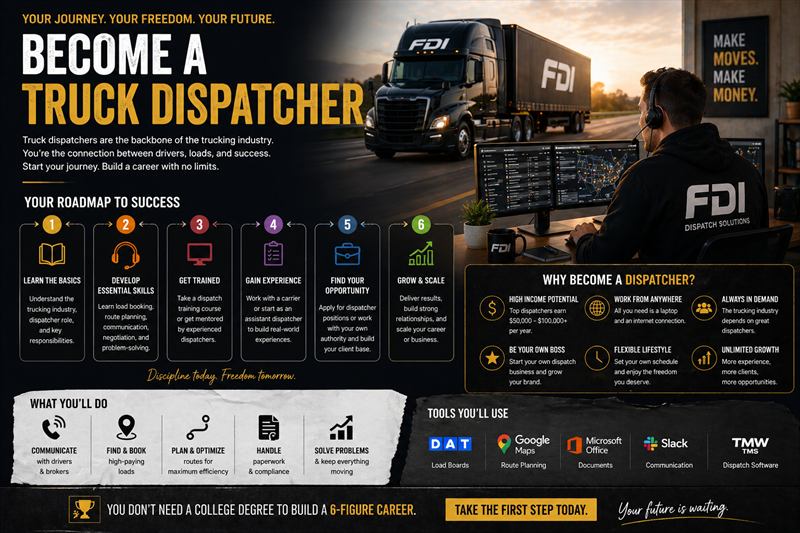
- Learn the fundamentals of US trucking, documents and hours of service rules.
- Get practical training on load boards, broker calls and rate negotiation.
- Set up your workspace with backup internet, power backup and a quality headset.
- Gain experience through a dispatch company role or supervised practice.
- Decide on your path: employment or independent dispatching.
- If independent, register your business, get accounting advice, prepare a dispatcher-carrier agreement and set up a US business phone line.
- Find your first carriers using the approaches in how to find owner-operator clients.
Train with an Amritsar-based dispatch instituteLearn US truck dispatching online with live practical sessions, DAT and Truckstop training and ongoing support.
Book a Free DemoFrequently Asked Questions
Can I do US truck dispatching part time from India?
It is possible, but dispatching needs you to be available during US business hours when brokers post loads and problems happen on the road. Part-time dispatchers usually handle fewer trucks and need a clear agreement with carriers about availability.
Do I need a US company to dispatch US trucks?
Not necessarily. Many dispatchers serve US carriers through a business registered in India. Some choose to form a US entity for business reasons. Discuss the options with qualified accountants or lawyers.
What English level do I need?
You need to understand fast, informal American English on the phone and speak clearly enough for brokers and drivers to follow. Practice with real call scenarios improves this quickly.
How long does it take to start dispatching from India?
You can learn the fundamentals in a few weeks of dedicated study and practice. Gaining the confidence and experience to work independently with carriers typically takes longer and comes from hands-on work.