In this guide
A truck dispatcher works for the carrier: they find loads, negotiate rates and manage paperwork on behalf of a trucking company or owner-operator, and they are paid by that carrier. A freight broker arranges transportation for shippers: they sell capacity to the shipper, hire a carrier to move the freight and earn the difference. Brokers must hold broker operating authority from the FMCSA and file financial security. Dispatchers who stay in the carrier's-agent role generally do not need broker authority, but dispatchers who start acting like brokers can face serious penalties.
Key takeaways
- Dispatchers represent carriers; brokers arrange transportation between shippers and carriers.
- Brokers need FMCSA broker authority, a BOC-3 filing and $75,000 in financial security (a surety bond or trust fund).
- US law allows penalties against dispatch services that engage in brokering without authority.
- Book loads in the carrier's name, never take payment from shippers, and never resell loads to other carriers.
Not legal advice
This article explains general principles for educational purposes, based on US federal rules and FMCSA guidance as of September 2026. The exact line between dispatching and brokering depends on the facts of your business. If you are unsure, speak with a US transportation attorney before you start operating.
Dispatcher vs Broker: The Short Comparison
| Truck dispatcher | Freight broker | |
|---|---|---|
| Represents | The carrier (trucking company or owner-operator) | The shipper's need to move freight; contracts with both shipper and carrier |
| Main job | Find loads for specific trucks, negotiate rates, handle carrier paperwork | Find carriers for shippers' freight and manage the shipment |
| Paid by | The carrier: a percentage of load revenue or a flat fee | The shipper pays the broker; the broker pays the carrier and keeps the margin |
| Handles freight payments? | No. The broker pays the carrier or its factoring company directly | Yes. Collects from the shipper and pays the carrier |
| FMCSA authority | Not required when acting only as the carrier's agent | Broker operating authority required |
| Financial security | Not required | $75,000 surety bond (BMC-84) or trust fund (BMC-85) |
| Name on the rate confirmation | The carrier's name and MC number | The broker's own company name and MC number |
What a Truck Dispatcher Does
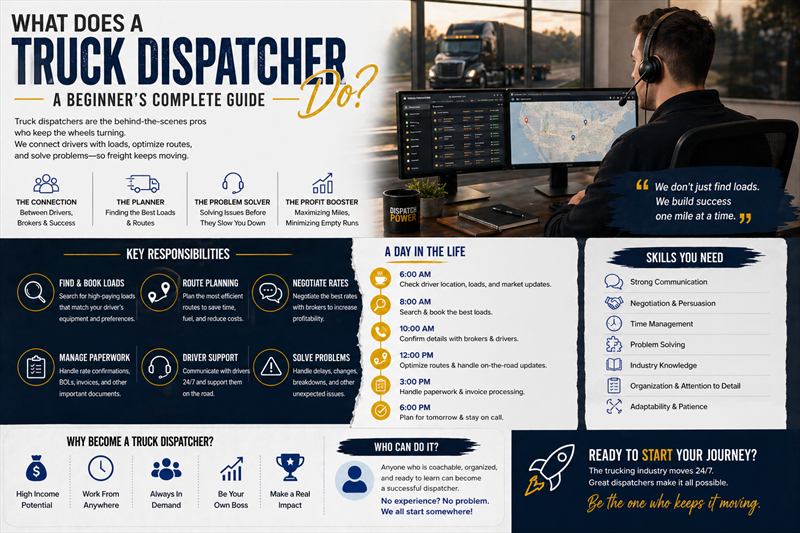
A dispatcher is part of the carrier's operation. They search load boards and call brokers to find loads for specific trucks, negotiate the rate, complete carrier packets, review rate confirmations and keep drivers updated. The contract for each load is between the broker and the carrier, and the carrier makes the final decision about which loads to haul. Read what a truck dispatcher does for a full breakdown of the role.
What a Freight Broker Does
A freight broker is a licensed intermediary. Brokers win business from shippers, agree a price to move their freight, then find a carrier to haul it at a lower price. The broker issues the rate confirmation, tracks the shipment, invoices the shipper and pays the carrier. Their income is the difference between what the shipper pays and what the carrier receives.
What brokers need to operate legally
- Broker operating authority from the FMCSA, identified by an MC number.
- A BOC-3 filing designating process agents in each state.
- $75,000 in financial security, filed as a BMC-84 surety bond or BMC-85 trust fund, which protects carriers and shippers if the broker does not pay.
When Does a Dispatcher Become a Broker?
US federal regulations exclude bona fide agents from the definition of a broker. In simple terms, a bona fide agent is part of the normal organization of a motor carrier and performs duties under the carrier's direction under a continuing agreement. In 2023, the FMCSA published guidance explaining how the broker and bona fide agent definitions apply to dispatch services.
A dispatch service is much more likely to be treated as a broker if it:
- Arranges transportation on behalf of shippers rather than on behalf of a specific carrier.
- Receives payment from shippers or brokers for the freight and then pays the carrier.
- Takes a load and decides which of several carriers gets it, or re-posts loads for other carriers to haul.
- Adds a markup to the freight charge rather than charging the carrier a service fee.
- Books loads in its own name instead of the carrier's name.
The penalties are real
Under US law, a person who knowingly engages in brokering without the required authority can face civil penalties of up to $10,000 per violation and can be held liable for valid claims from injured parties. The 2021 Infrastructure Investment and Jobs Act expanded these penalties so they clearly apply to dispatch services, and it made company officers who knowingly authorize violations jointly liable.
How Dispatchers Stay on the Right Side of the Line
- Sign a written agreement with each carrier describing you as the carrier's dispatcher and agent, with the carrier authorizing you to act on its behalf.
- Work for the truck, not the load. Search for freight for a particular carrier's truck, rather than collecting loads and shopping them to carriers.
- Book in the carrier's name. Rate confirmations should show the carrier's legal name and MC number.
- Keep freight money out of your hands. The broker pays the carrier or its factoring company directly. You invoice the carrier separately for your dispatch fee.
- Never charge shippers and never add a markup to the freight rate.
- Be transparent with brokers that you are dispatching on behalf of the named carrier.
- Get legal advice if your business model involves anything beyond carrier-side dispatch services.
Dispatcher or Broker: Which Career Is Right for You?
Dispatching has lower start-up requirements and focuses on serving carriers. It suits people who enjoy operations, negotiation and building long-term relationships with owner-operators.
Brokerage requires authority, financial security, more capital to pay carriers before shippers pay, and a sales focus on winning shipper accounts. Some people start as dispatchers, learn the freight market and later open a licensed brokerage.
If you are starting out, see how to become a truck dispatcher and how to find owner-operator clients.
Build a compliant dispatch businessOur training covers the dispatcher's role, carrier agreements and business setup guidance.
Book a Free DemoFrequently Asked Questions
Do truck dispatchers need an MC number?
A dispatcher acting only as the carrier's agent does not need its own MC number or broker authority. Loads are booked under the carrier's MC number. If your activities cross into brokering, you would need broker authority.
Can a dispatcher work with more than one carrier?
Yes, many independent dispatchers work with several carriers. The key is that you act for each carrier under a written agreement and find loads for that carrier's trucks, rather than taking loads and deciding which carrier gets them.
Can a dispatcher collect payment for loads?
Dispatchers should not receive the freight payment and pass it on to the carrier, because handling the money exchanged for transportation is associated with brokering. The broker should pay the carrier or its factoring company directly.
How much does a freight broker earn compared with a dispatcher?
Brokers earn the margin between the shipper rate and the carrier rate, while dispatchers usually earn a percentage of the carrier's revenue or a flat fee. Brokerage can earn more per load but carries more risk, capital needs and regulatory requirements.