In this guide
- What Is a Truck Dispatcher?
- The Main Responsibilities of a Truck Dispatcher
- A Day in the Life of a Truck Dispatcher
- In-House vs Independent Dispatcher
- Skills Every Truck Dispatcher Needs
- Tools Dispatchers Use Every Day
- What a Dispatcher Does Not Do
- How Truck Dispatchers Get Paid
- Is Truck Dispatching a Good Career?
- Frequently Asked Questions
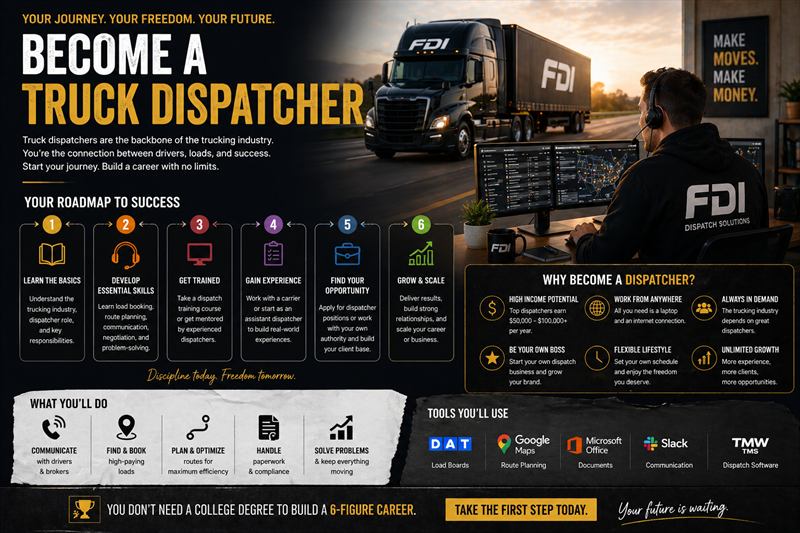
A truck dispatcher is the person who keeps a trucking business moving. Dispatchers find freight for trucks, negotiate the rate with the freight broker or shipper, plan the route around the driver's legal driving hours, handle the paperwork and stay in contact with the driver until the load is delivered and paid. In short, the driver moves the freight and the dispatcher makes sure there is always profitable freight to move.
This guide explains exactly what the job involves, what a typical day looks like, the skills and tools you need, and how dispatchers get paid. If you are thinking about a career in freight dispatching, start here.
Key takeaways
- Dispatchers work for the carrier (the trucking company or owner-operator), finding loads and negotiating rates on its behalf.
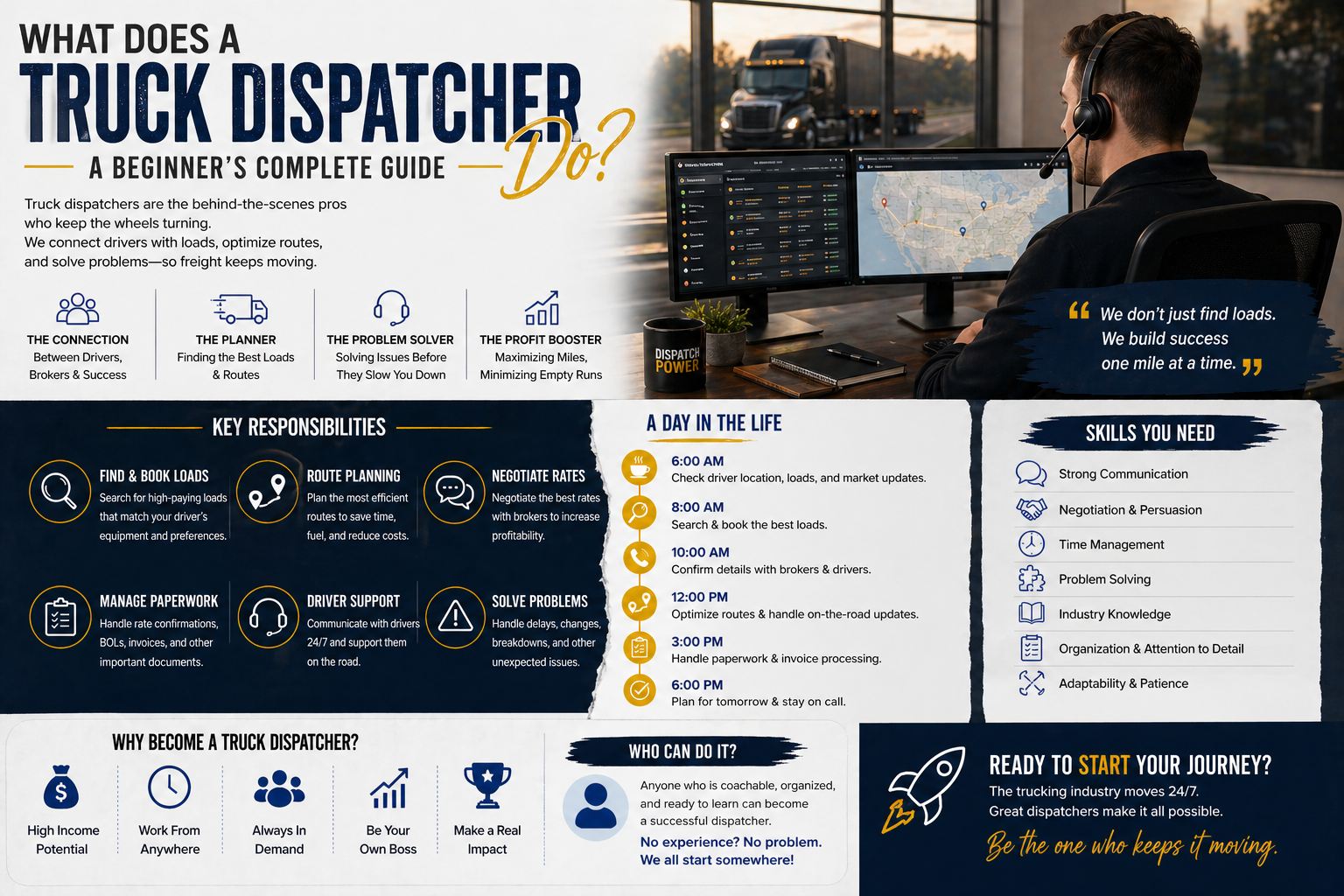
- The core duties are load booking, rate negotiation, route and schedule planning, paperwork, driver communication and problem solving.
- Most of the work happens on the phone, by email and on load boards such as DAT and Truckstop, so it can be done remotely.
- No license is required to be a dispatcher, but dispatchers must not act as freight brokers without broker authority.
What Is a Truck Dispatcher?
In US trucking, freight moves through three main parties. Shippers have goods to move. Freight brokers connect shippers with trucking companies. Carriers own or operate the trucks. A truck dispatcher sits on the carrier's side of this relationship. When a broker posts a load, the dispatcher is the one who calls, asks the right questions, negotiates the price and books the load for their truck.
Dispatchers work in two main settings:
- In-house dispatchers are employed by a trucking company and manage that company's fleet, often alongside safety, billing and maintenance teams.
- Independent dispatchers run their own dispatch service and work with several owner-operators or small fleets that do not have their own dispatch staff. They are usually paid a percentage of each load's revenue or a flat weekly fee.
Either way, the dispatcher's goal is the same: keep each truck loaded with good-paying freight while keeping the driver safe, legal and satisfied.
The Main Responsibilities of a Truck Dispatcher
1. Finding and booking loads
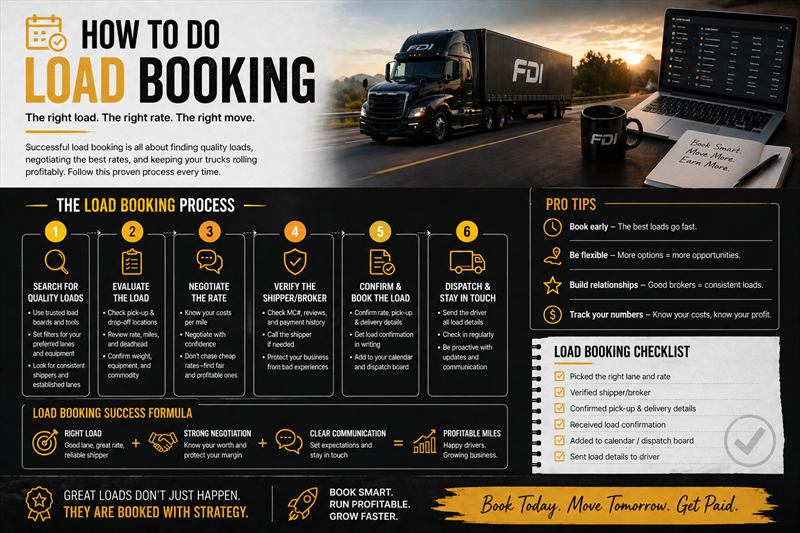
Dispatchers search load boards, contact brokers they already work with and follow up on regular lanes to find freight that fits the truck's equipment, location and schedule. A good dispatcher does not just grab the first load; they compare options, think about where the truck will be after delivery and plan the next load before the current one ends. We break this process down step by step in how load booking works.
2. Negotiating rates
Posted rates are usually a starting point. Dispatchers research what the lane is paying, calculate the carrier's costs and negotiate with brokers for a fair rate, plus extra pay for things like detention, extra stops or a truck order not used. Learn the tactics in our guide to negotiating freight rates with brokers.
3. Planning routes and schedules
Every load has a pickup appointment and a delivery appointment. The dispatcher checks that the driver can reach both on time without breaking the federal hours of service rules, and plans fuel stops, rest breaks and the most efficient route. Planning also means reducing deadhead (empty miles) between one delivery and the next pickup.
4. Handling paperwork
Before a carrier can haul for a new broker, the dispatcher completes a carrier packet with documents such as the operating authority, insurance certificate and W-9. For every load, the dispatcher reviews the rate confirmation, and after delivery collects the signed bill of lading (proof of delivery) so the carrier can invoice. See dispatch paperwork explained for each document in detail.
5. Communicating with drivers and brokers
Dispatchers send load details to drivers, confirm pickup and delivery, and provide status updates (often called check calls) to brokers. Clear communication prevents missed appointments and builds the relationships that lead to better loads later.
6. Solving problems on the road
Trucks break down, shippers run late, receivers refuse freight and weather closes roads. When something goes wrong, the dispatcher is the person who calls the broker, reschedules appointments, documents detention time and finds a solution so the driver can keep moving.
7. Supporting billing and payment
Many dispatchers also send invoices to brokers or submit paperwork to a factoring company, track payments and follow up on late ones. Getting paid on time is just as important as booking a good rate.
A Day in the Life of a Truck Dispatcher
No two days are identical, but most follow a similar rhythm built around US business hours. Because many of our students work with US carriers from India, the table below also shows the matching Indian Standard Time (IST) when the US is on daylight saving time. From November to March, add one hour to the IST times.
| US Eastern Time | India (IST) | Typical tasks |
|---|---|---|
| 6:00 AM | 3:30 PM | Check where each driver is, how many driving hours they have left and what the market looks like today. |
| 8:00 AM | 5:30 PM | Search load boards, call brokers and book the best loads for trucks that are empty or delivering soon. |
| 10:00 AM | 7:30 PM | Confirm pickup details with brokers and drivers, review rate confirmations and send dispatch instructions. |
| 12:00 PM | 9:30 PM | Handle on-the-road updates: late appointments, detention, route changes and check calls. |
| 3:00 PM | 12:30 AM | Process paperwork from delivered loads, send invoices and follow up on payments. |
| 6:00 PM | 3:30 AM | Plan tomorrow's loads, line up reloads and stay reachable for any late issues. |
In-House vs Independent Dispatcher
| In-house dispatcher | Independent dispatcher | |
|---|---|---|
| Works for | One trucking company | Several owner-operators or small fleets |
| How they are paid | Salary or hourly wage, sometimes bonuses | Percentage of each load's gross revenue or a flat weekly fee per truck |
| Income stability | More predictable | Depends on the number of trucks and how much they earn |
| Responsibilities | Often specialized, with support from other departments | Handles everything: sales, dispatch, paperwork and client service |
| Best for | Beginners who want structure and on-the-job learning | People who want to build their own business |
Skills Every Truck Dispatcher Needs
- Clear, confident communication. You will spend much of the day on calls with brokers and drivers, so spoken and written English matters.
- Negotiation. Knowing your numbers and asking for a fair rate is the difference between a profitable truck and a struggling one.
- Basic math. Rate per mile, cost per mile, deadhead and fuel costs come up on every load. See how to calculate rate per mile.
- US geography. Knowing major freight markets, highways and regions helps you plan reloads and avoid dead zones.
- Time management and multitasking. Several trucks, brokers and deadlines need attention at once.
- Attention to detail. A wrong appointment time or missed line on a rate confirmation can cost real money.
- Calm problem solving. Breakdowns and delays are normal. Staying calm keeps drivers and brokers working with you.
- Industry knowledge. Terms like BOL, TONU, lumper and reefer should become second nature. Our freight dispatch glossary is a good place to start.
Tools Dispatchers Use Every Day
- Load boards such as DAT and Truckstop to find freight and check market rates.
- A transportation management system (TMS) or spreadsheets such as Google Sheets to track loads, drivers and invoices.
- Truck-friendly mapping tools to estimate miles, drive time and routes that suit commercial vehicles.
- ELD and GPS portals to see a driver's location and remaining hours, when the carrier gives access.
- FMCSA's public records (such as the SAFER and Licensing & Insurance systems) to verify brokers and carriers.
- Phone, email and messaging for broker calls, rate confirmations and driver updates.
What a Dispatcher Does Not Do
Understanding the limits of the role is just as important as knowing the duties:
- A dispatcher is not a freight broker. Dispatchers represent the carrier. Arranging freight for shippers, taking payment from shippers or reselling loads is brokering, which requires broker authority from the FMCSA. Read truck dispatcher vs freight broker to understand where the line is.
- A dispatcher does not force drivers to take loads or break rules. The driver and carrier decide which loads to accept, and no one may pressure a driver to exceed hours of service limits.
- A dispatcher does not own the carrier's authority. Loads are booked in the carrier's name, under the carrier's MC number, and the broker pays the carrier (or its factoring company) directly.
How Truck Dispatchers Get Paid
In-house dispatchers are usually paid a salary or hourly wage. Independent dispatchers commonly charge carriers a percentage of each load's gross revenue, often somewhere between 5% and 10%, or a flat weekly fee per truck. Income for an independent dispatcher therefore depends on how many trucks they manage, how much those trucks earn and how well they keep clients over time. Be cautious of anyone promising a guaranteed income: freight markets rise and fall, and results depend on skill and effort.
Want to see dispatching in action?Watch live load booking and broker calls in a free demo class before you decide on training.
Book a Free DemoIs Truck Dispatching a Good Career?
For organized people who enjoy communication and problem solving, dispatching can be a rewarding career. It does not require a college degree, the skills can be learned through focused training and practice, and much of the work can be done from home. It also has real challenges: long or night-time hours when working with US time zones from abroad, pressure when things go wrong, and income that depends on the freight market. The dispatchers who succeed treat it as a professional skill, keep learning and build honest long-term relationships with carriers and brokers.
If you are ready for the next step, read our roadmap on how to become a truck dispatcher.
Frequently Asked Questions
Do truck dispatchers need a license?
There is no federal license for truck dispatchers in the United States. However, if a dispatch service performs broker activities, such as arranging transportation for shippers or handling payments between shippers and carriers, it needs broker authority from the FMCSA. Independent dispatchers should also follow the business registration and tax rules of the country where they operate.
Can a truck dispatcher work from home?
Yes. Dispatching is done by phone, email and web-based software, so many dispatchers work remotely, including people in India supporting US carriers. You need a reliable internet connection, a computer, a good headset and a professional way to call US numbers.
How many trucks can one dispatcher handle?
It depends on the type of freight, how many loads each truck runs per week and how much paperwork the dispatcher handles. Beginners usually start with a few trucks and add more as their systems and experience improve.
What is the hardest part of being a dispatcher?
Most dispatchers say it is handling several urgent problems at once, such as a late pickup, a breakdown and a slow-paying broker, while still booking the next loads. Strong organization and clear communication make this far easier.